

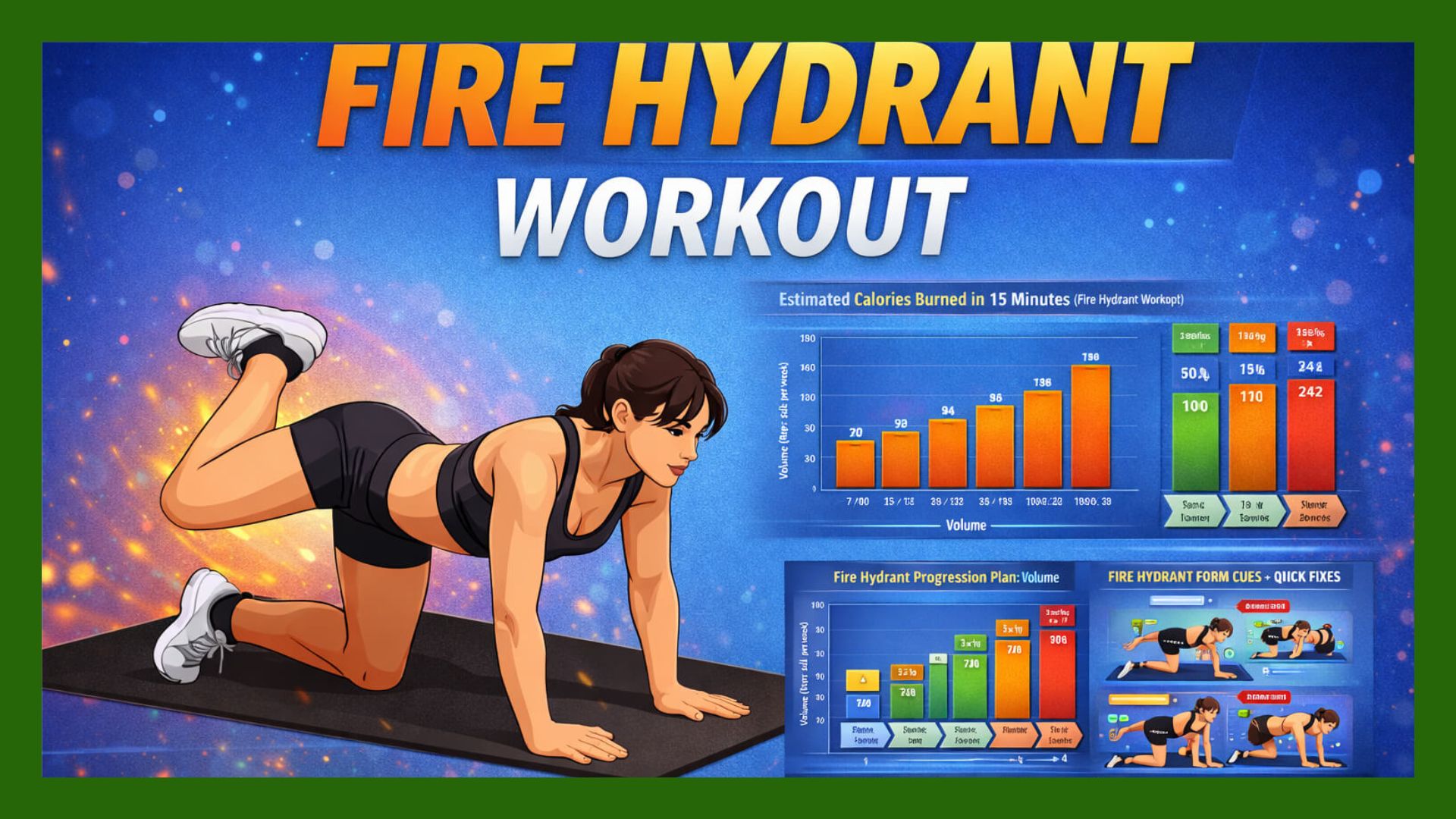
If you’ve ever seen someone in a gym (or living room) lifting their bent leg out to the side on all fours—yep, that’s the fire hydrant. It’s also called a quadruped hip abduction. Done well, it’s one of the simplest ways to train your glute medius (the side glute that helps stabilize your hips and pelvis) and build “quiet strength” that carries into running, lifting, and everyday movement.
Below is a complete fire hydrant workout guide with science-backed context, estimated calorie data, progression planning, and a downloadable infographic you can share or use as a checklist.
What is a “fire hydrant workout”?
A fire hydrant workout usually means one of two things:
- The exercise: fire hydrants as a stand-alone strength move (sets + reps, slow tempo).
- A circuit: fire hydrants plus other glute/core moves performed back-to-back for a pump + conditioning effect.
Either way, the star is the same: hip abduction/external rotation in a quadruped position, which emphasizes the hip stabilizers (especially portions of the glute med and glute max).
Muscles trained (and why you should care)
Fire hydrants primarily challenge:
- Gluteus medius (especially for lateral hip stability)
- Gluteus maximus (depending on your angle/variation)
- Core + trunk stabilizers (to prevent twisting/arching)
- Shoulders/scapular stabilizers (because you’re supporting yourself on your hands)
A 2025 narrative review on hip abductor strengthening notes the fire hydrant can activate the posterior gluteus medius and gluteus maximus, supporting its use for hip stability work.
And EMG research on glute-focused strengthening highlights that different exercises recruit glute regions differently, reinforcing the value of including targeted hip abductor work in a balanced plan.
Benefits (realistic, evidence-aligned)
1) Better hip stability for sport + daily movement
The glute med helps control hip position—important for single-leg tasks (stairs, running, lunges).
2) Stronger glutes without heavy equipment
Because it’s bodyweight-friendly, it’s easy to train consistently—at home or in the gym.
3) Easy to scale for strength or conditioning
You can make fire hydrants:
- Strength-focused (slow tempo, longer pauses, more tension)
- Conditioning-focused (circuits with minimal rest)
4) Works well inside standard strength guidelines
General recommendations from ACSM include training major muscle groups at least two days per week, with common rep targets like 8–12 reps (or higher reps for endurance), depending on your goal and training age.
Safety note: If you get sharp hip pinching, numbness/tingling, or back pain that escalates, stop and adjust range of motion or consult a clinician.
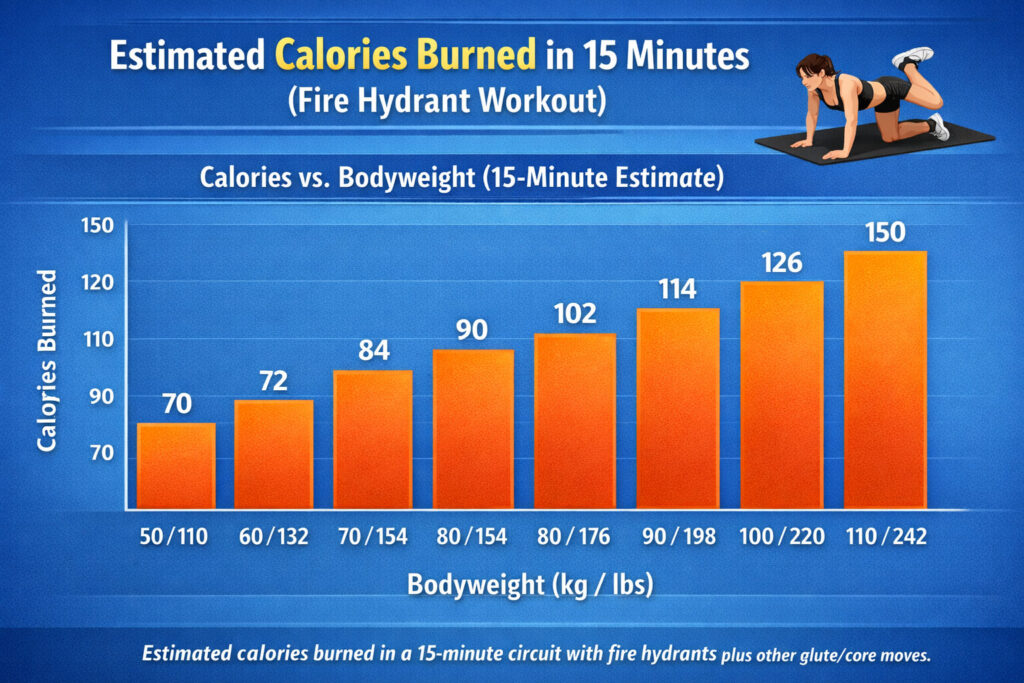
Data: how many calories does a fire hydrant workout burn?
Calorie burn varies a lot by intensity, rest time, body mass, and fitness level—so think of this as a planning estimate, not a promise.
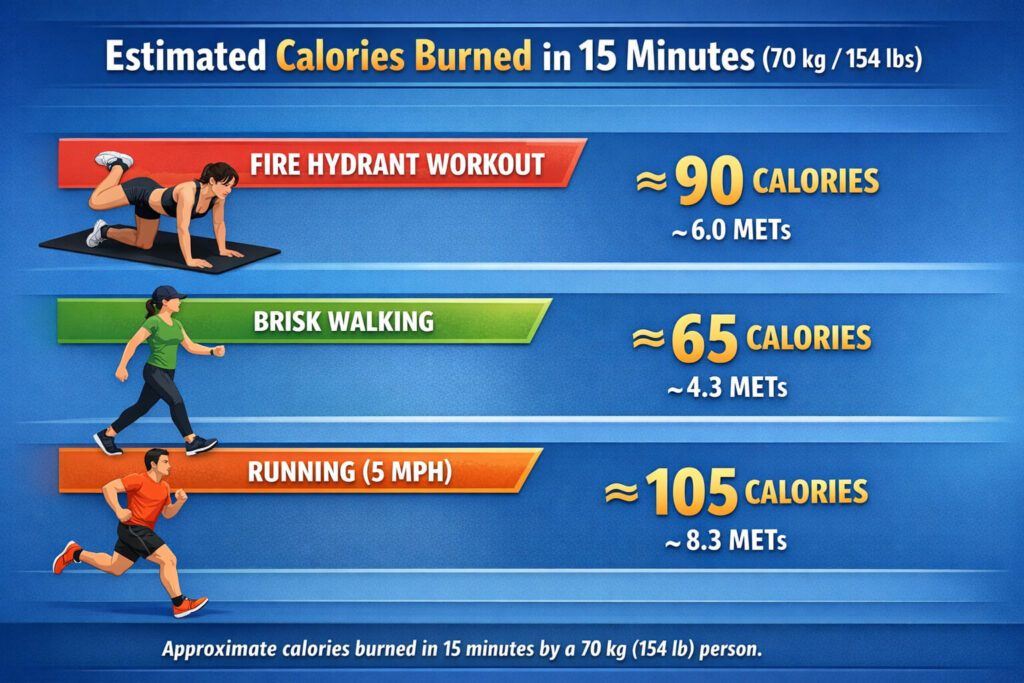
The Compendium of Physical Activities lists MET values for bodyweight circuit training (example: 6.0 METs) and for activities like brisk walking and running.
Example: 15 minutes, 70 kg body mass (estimated)
Using MET-based estimation:
- Bodyweight circuit training: ~6.0 METs
- Brisk walking: ~4.3 METs
- Running 5 mph: ~8.3 METs
The perfect fire hydrant (form checklist)
Use this cue stack to keep the work where you want it: the hips/glutes.
Setup
- Hands under shoulders, knees under hips, outer thigh
- Brace lightly (ribs down), neutral spine
Lift
- Keep knee bent ~90°
- Lift the thigh out to the side only as high as you can without pelvis rotation
- Imagine “hip headlights” pointing straight down
Peak + control
- Pause 1–2 seconds at the top
- Lower slowly (2–3 seconds)
Most common mistakes
- Over-arching the low back
- Twisting the pelvis open to “cheat” higher
- Going too fast (momentum replaces tension)
Data table: fire hydrant variations (with goals + difficulty)
| Variation | What it biases | Best for | Difficulty | Key cue |
|---|---|---|---|---|
| Classic fire hydrant | Glute med + hip control | Beginners, form | ⭐ | “Hips square” |
| Paused reps (2s top) | Time under tension | Strength + stability | ⭐⭐ | “Own the top” |
| Slow eccentric (3s down) | Control + endurance | Tendon-friendly loading | ⭐⭐ | “Lower like a brake” |
| Banded (band above knees) | Lateral glute demand | Glute med burn | ⭐⭐⭐ | “Push out, don’t twist” |
| Pulses (top 10–20s) | Metabolic stress | Finishers | ⭐⭐⭐ | “Small range, big burn” |
| Straight-leg hydrant | Longer lever = harder | Advanced | ⭐⭐⭐⭐ | “Don’t arch back” |
Three complete fire hydrant workouts (pick your vibe)
Workout A: Strength + stability (12–18 minutes)
- Fire hydrant (paused): 3 × 8–12/side
- Side plank (or side plank knees-down): 3 × 20–40 sec/side
- Glute bridge: 3 × 10–15
Rest 45–90 sec between sets.
Workout B: Glute pump (10–15 minutes)
Do 3 rounds:
- Banded fire hydrant: 12–15/side
- Frog pumps: 20
- Wall sit (or squat hold): 30–45 sec
Rest 45–60 sec between rounds.
Workout C: Conditioning circuit (15 minutes)
Set a timer for 15 minutes. Cycle through:
- Fire hydrant: 10/side
- Bodyweight squat: 12
- Mountain climbers: 30 sec
- Dead bug: 8/side
Keep rests short; scale intensity by slowing down or reducing reps.
(This is the style that aligns most closely with the Compendium “bodyweight circuit training” MET estimate.)
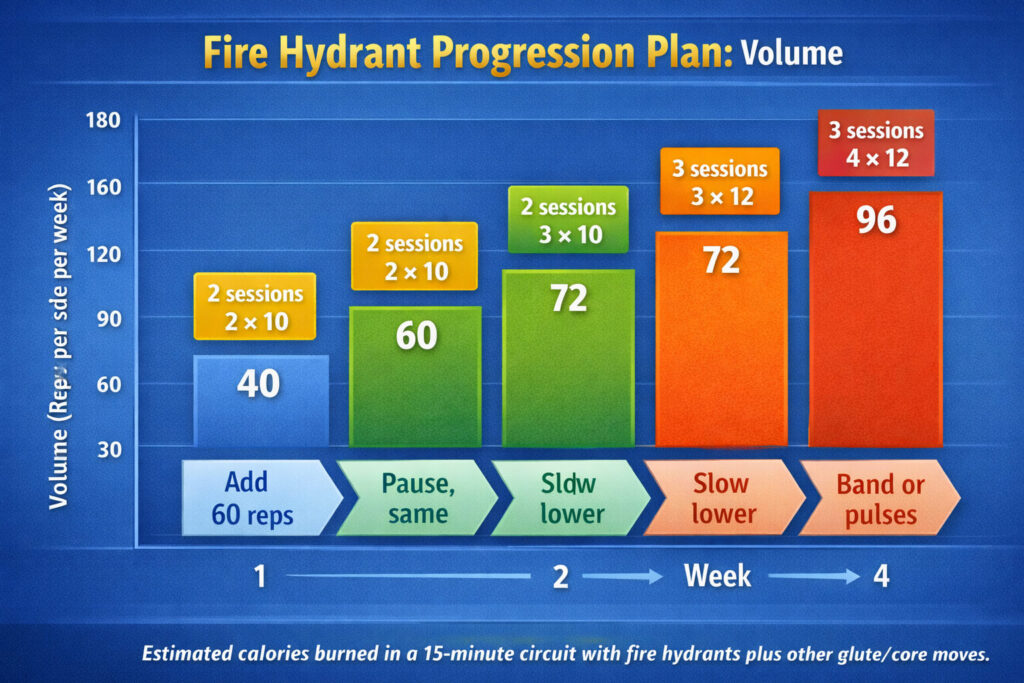
A 4-week progression plan (simple, effective)
Here’s a clean ramp from beginner → intermediate:
| Week | Sessions/week | Sets × reps/side | Tempo focus |
|---|---|---|---|
| 1 | 2 | 2 × 10 | Smooth control |
| 2 | 2 | 3 × 10 | Add 1–2s pause |
| 3 | 3 | 3 × 12 | Slower lower (2–3s) |
| 4 | 3 | 4 × 12 | Add band or pulses |
Warm-up & mobility (5 minutes)
- Hip circles (standing or quadruped): 30–45 sec/side
- Cat-cow: 6–8 reps
- Glute bridge (easy): 10 reps
- Bodyweight squat to comfortable depth: 8 reps
FAQ (quick wins)
What does the fire hydrant exercise do?
The fire hydrant is a quadruped hip abduction move that trains your side glutes (gluteus medius) and hip stabilizers. In plain terms: it helps you build hip stability, improve pelvic control, and strengthen the muscles that keep your knees and hips tracking well during walking, running, squats, lunges, and single-leg work.
Do fire hydrants really grow glutes?
They can, but with a realistic expectation:
- Fire hydrants are strongest for glute medius development (the “side glute” shape and stability).
- They can also contribute to glute max growth, especially if you use progressive overload (bands, pauses, slow tempo, higher weekly volume) and pair them with bigger glute movements (hip thrusts/bridges, squats, RDLs, step-ups).
If your goal is maximum glute size, fire hydrants are best as an accessory—great for rounding out the hips and improving control—while heavier compound patterns do most of the size-building work.
How many fire hydrants should I do to see results?
A good starting target for most people is:
- 2–3 days/week
- 2–4 sets per side
- 8–15 reps per set (or 20–30 reps if bodyweight is too easy)
That typically lands you around 60–180 quality reps per side per week, depending on level.
Results depend on consistency and progression:
- 1–2 weeks: better mind-muscle connection, less hip wobble
- 3–6 weeks: noticeable strength/endurance improvements
- 6–12 weeks: visible changes (especially if nutrition + overall training support your goal)
Do fire hydranttis really work?
Yes—if you do them correctly and progress them. Fire hydrants “work” best when:
- Your hips stay square (no twisting open to cheat higher)
- You use a controlled tempo (slow down + brief pause at the top)
- You increase challenge over time (more sets/reps, bands, longer pauses, slower lowers, harder variations)
If you rush reps, swing the leg, or crank the back, you’ll feel less glute and more hip flexor/low-back—so technique matters more here than with many other glute exercises.
