

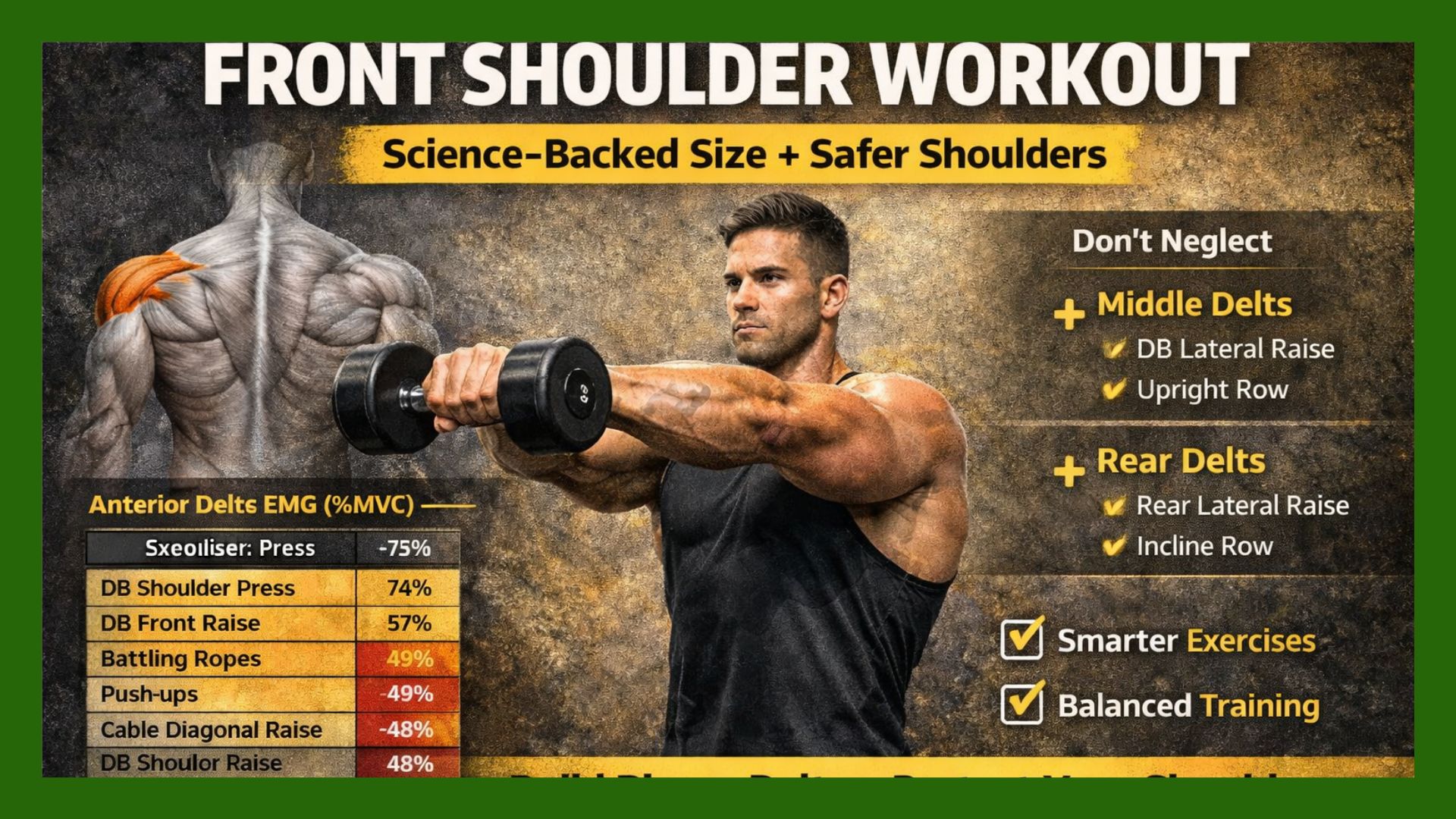
If your front shoulders look flat from the side, or your overhead pressing feels “stuck,” your anterior delts probably need smarter training—not just more random front raises. The anterior deltoid’s main jobs are shoulder flexion (lifting your arm in front of you) and helping with pressing, and it also contributes to stabilizing the shoulder joint during loaded movement.
The catch is: most people already hit front delts hard through benching, incline work, and overhead pressing, so going “all-in” on front raises can create that rounded-shoulder posture vibe and cranky shoulder feelings unless you balance it with rear delts + upper back.
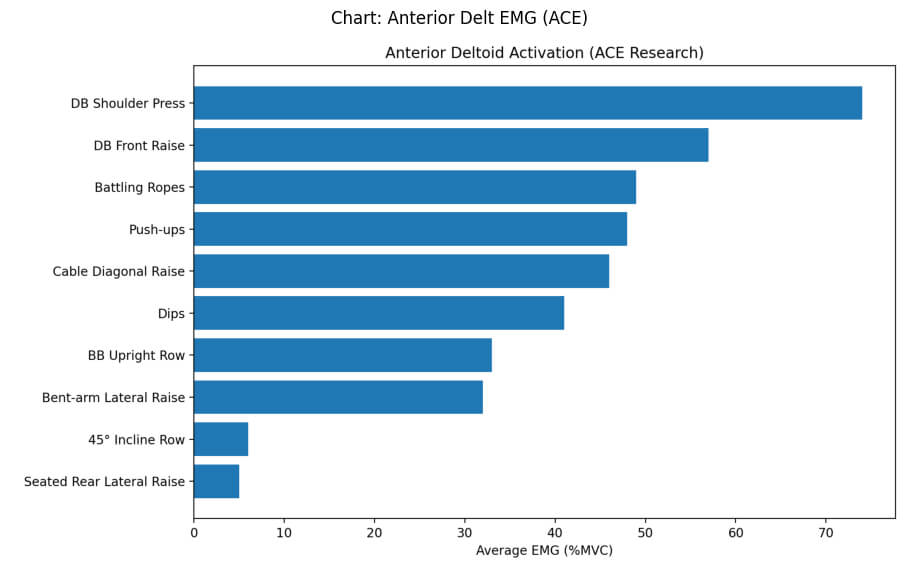
The data: which exercises light up the front delts the most?
One of the clearest, practical datasets comes from ACE research (UW–La Crosse lab) using EMG (%MVC). In that study, subjects performed 10 popular shoulder moves and researchers compared average activation; the dumbbell shoulder press produced significantly higher anterior-delt activation than every other exercise tested.
Here’s the exact anterior-delt table (mean ± SD) from that ACE dataset:
| Exercise | Avg EMG (%MVC) |
|---|---|
| DB Shoulder Press | 74 ± 15.9 |
| DB Front Raise | 57 ± 11.9 |
| Battling Ropes | 49 ± 16.0 |
| Push-ups | 48 ± 14.5 |
| Cable Diagonal Raise | 46 ± 19.0 |
| Dips | 41 ± 15.5 |
| BB Upright Row | 33 ± 15.2 |
| Bent-arm Lateral Raise | 32 ± 18.5 |
| 45-degree Incline Row | 6 ± 4.0 |
| Seated Rear Lateral Raise | 5 ± 4.1 |
Now here’s the big insight: if you only train what you feel in the mirror (front delts), you miss the middle/rear heads that keep shoulders looking wide and moving smoothly. Even the ACE researchers stress that “there’s not one best exercise for targeting the shoulders,” because no single move maximally activates all three delt heads at once.
Quick reality check: why “front delts only” is a trap
ACE’s lead researcher warns that stacking front raises + presses + lateral raises can double up on anterior delts while neglecting the posterior delts—so you’re not getting a well-rounded shoulder. Also, independent research comparing exercises finds shoulder press and lateral raise tend to produce higher anterior and middle delt activation than bench press variations, which supports using at least one true shoulder-focused press in a delt plan (not only chest pressing).
The balanced approach: build front delts while protecting your shoulders
Here’s the simplest way to program it: start with one heavy-ish press (highest payoff for front delts), then add one “front-delt biased” raise pattern, then finish with a rear-delt / upper-back movement so the joint stays happy over time. This is also consistent with ACE’s practical takeaway that you should target more than one delt region and be intentional about what each exercise hits.
To show why balance matters, here are the ACE tables for the middle and posterior delts (same 10 exercises). Notice how the best moves change:
Middle delt (mean ± SD, %MVC):
| Exercise | Avg EMG (%MVC) |
|---|---|
| 45-degree Incline Row | 84 ± 14.5 |
| Bent-arm Lateral Raise | 77 ± 16.1 |
| Cable Diagonal Raise | 74 ± 15.1 |
| BB Upright Row | 73 ± 13.3 |
| Seated Rear Lateral Raise | 70 ± 14.6 |
| DB Shoulder Press | 62 ± 18.6 |
| Battling Ropes | 37 ± 19.3 |
| DB Front Raise | 36 ± 15.5 |
| Push-ups | 13 ± 11.5 |
| Dips | 7 ± 3.5 |
Posterior delt (mean ± SD, %MVC):
| Exercise | Avg EMG (%MVC) |
|---|---|
| Seated Rear Lateral Raise | 73 ± 9.9 |
| 45-degree Incline Row | 69 ± 14.0 |
| Battling Ropes | 38 ± 22.0 |
| Cable Diagonal Raise | 35 ± 17.0 |
| Bent-arm Lateral Raise | 33 ± 14.4 |
| BB Upright Row | 31 ± 11.5 |
| Dips | 26 ± 53.4 |
| DB Shoulder Press | 10 ± 5.4 |
| DB Front Raise | 9 ± 5.8 |
| Push-ups | 6 ± 5.7 |
Pro quotes
ACE’s study authors put it bluntly: “There’s not one best exercise for targeting the shoulders.”
And their programming warning is gold for readers: “You have to target the shoulder with more than one exercise.”
On technique, strength coach Bret Contreras notes the common cue to “keep the shoulder blades down and back,” but argues that forcing scapular bracing during loaded shoulder movement can cause problems for some lifters—so let the scapula move naturally.
For mobility/readiness, coach Brian Murray describes the goal as to “open the front side of the shoulder complex without cranking into an unstable position.”
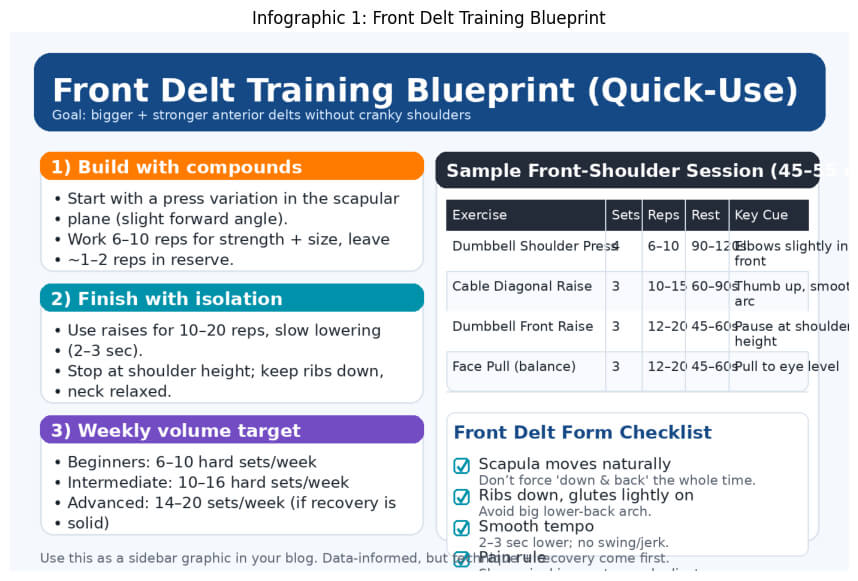
The workout: front-delt growth session (gym, 45–55 minutes)
This is a complete “front shoulder” workout that still respects shoulder health by pairing your front-delt work with rear-delt balance.
| Order | Exercise | Sets | Reps | Rest | How it should feel |
|---|---|---|---|---|---|
| 1 | Dumbbell Shoulder Press (slight forward/scapular plane) | 4–5 | 6–10 | 90–120s | Heavy but smooth, no grinding |
| 2 | Cable Diagonal Raise (low-to-high, thumb slightly up) | 3–4 | 10–15 | 60–90s | Front delt + upper chest “burn,” controlled |
| 3 | Dumbbell Front Raise (strict) | 3 | 12–20 | 45–60s | Pure front-delt pump, no swinging |
| 4 | Rear-delt finisher: Seated Rear Lateral Raise OR Face Pull | 3–4 | 12–20 | 45–60s | Rear delts/upper back lit up |
Form cues that keep your shoulders feeling good (and still grow the front delts)
On presses, don’t flare elbows straight out to 90° like a T; keep them slightly in front of your body (scapular plane) so the shoulder tracks cleanly. On raises, stop around shoulder height, keep ribs down (don’t turn it into a lower-back extension), and control the lowering for 2–3 seconds. If you feel sharp pinching deep in the joint (not normal muscle burn), lighten the load, shorten range slightly, and try a cable diagonal raise instead of straight front raises.
Progression rules (simple and effective)
Use double progression: keep the same weight until you can hit the top of the rep range on all sets with clean form, then add a small load next week. For example, shoulder press at 4×6–10: once you can do 10,10,9,9 with perfect control, bump the dumbbells by the smallest increment you have and repeat. For raises, progress slower—add reps first, then load.

Common mistakes that kill front-delt gains (or irritate shoulders)
The biggest one is swinging front raises (momentum moves the weight, not your delts). The second is doing too much front-delt isolation on top of heavy pressing volume from chest days—your anterior delts might already be at their recovery limit. The third is locking your shoulder blades “down and back” on every rep; for overhead work, scapulae naturally rotate—forcing a fixed position can feel awful for many people.
How often should you train front delts?
For most people, direct front-delt work 1–2x/week is enough if you already bench/incline/overhead press. If you’re prioritizing shoulders, you can run the session above once weekly and keep chest pressing moderate, or split it into two shorter sessions (press-focused day + raise-focused day). Recovery signs matter: if your front shoulder feels achy at rest or you lose pressing strength week to week, reduce isolation volume first.
Safety note:
If you have persistent shoulder pain, numbness/tingling, or sharp pinching that doesn’t improve with load/range changes, get it assessed by a qualified clinician before pushing volume.
