

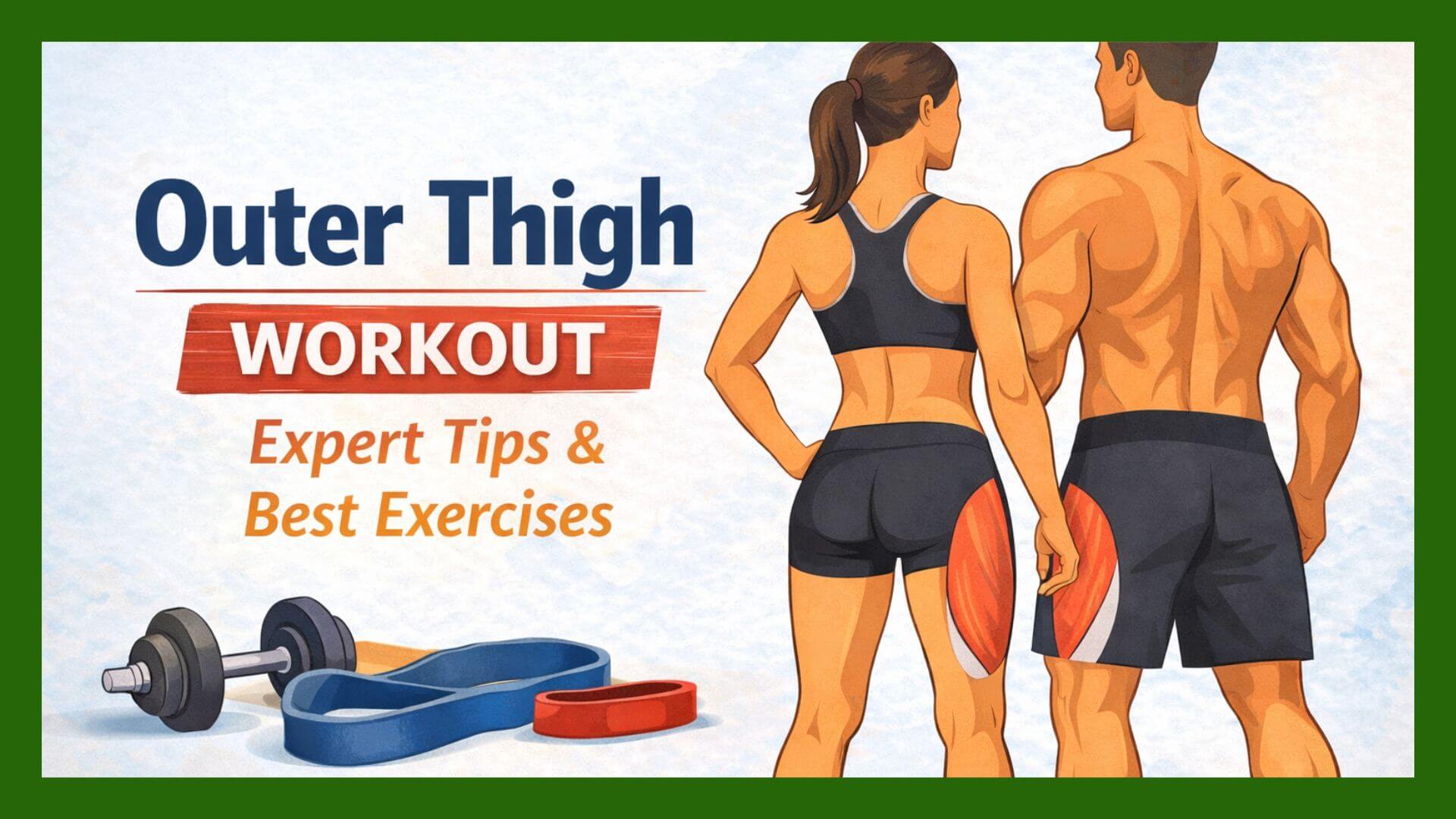
When people talk about “toning the thighs,” they’re often unknowingly referring to the outer thighs, a region dominated by the hip abductor muscles—especially the gluteus medius and tensor fasciae latae. These muscles play a crucial role in lower-body stability, posture, athletic performance, and injury prevention. A well-designed outer thigh workout doesn’t just improve appearance; it enhances how your entire lower body moves and feels.
Understanding the Outer Thigh Muscles
The outer thigh area is not a single muscle but a functional group that works together during lateral movement and single-leg stability.
| Muscle | Primary Function | Why It Matters |
|---|---|---|
| Gluteus Medius | Hip abduction, pelvic stability | Prevents knee collapse and lower-back strain |
| Tensor Fasciae Latae (TFL) | Assists hip abduction and rotation | Supports walking, running, and balance |
| Upper Glute Max | Hip extension and external rotation | Adds strength and shape to the outer thigh |
| IT Band (connective tissue) | Force transmission | Stabilizes the knee and hip |
Strong outer thighs are especially important for runners, cyclists, and anyone who spends long hours sitting, as weakness here often leads to knee pain or hip discomfort.
What Science Says About Outer Thigh Activation
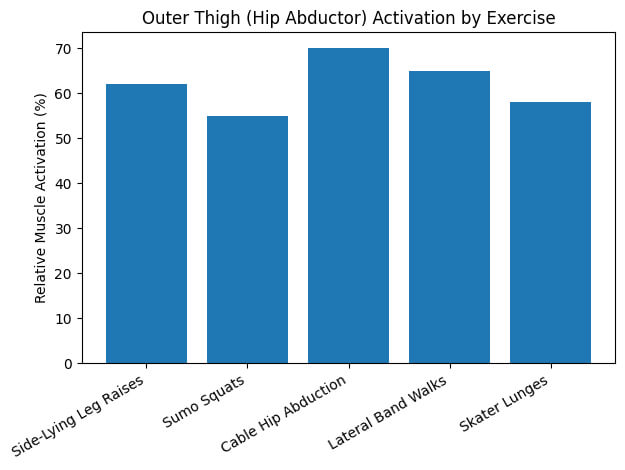
Electromyography (EMG) studies show that lateral and unilateral movements activate the outer thigh muscles more effectively than straight-line leg exercises. The chart above illustrates relative muscle activation across common outer thigh exercises, with cable hip abductions and lateral band walks ranking highest.
Key insight: Exercises that resist sideways motion or require balance consistently outperform machine-based leg movements.
Best Outer Thigh Exercises (Ranked by Effectiveness)
| Exercise | Equipment | Difficulty | Best For |
|---|---|---|---|
| Cable Hip Abduction | Cable machine | Medium | Maximum isolation |
| Lateral Band Walks | Resistance band | Easy–Medium | Activation & rehab |
| Side-Lying Leg Raises | Bodyweight | Easy | Beginners |
| Sumo Squats | Dumbbell/barbell | Medium | Strength + inner/outer thighs |
| Skater Lunges | Bodyweight | Medium–Hard | Athletic conditioning |
Sample Outer Thigh Workout Routine
| Exercise | Sets | Reps |
|---|---|---|
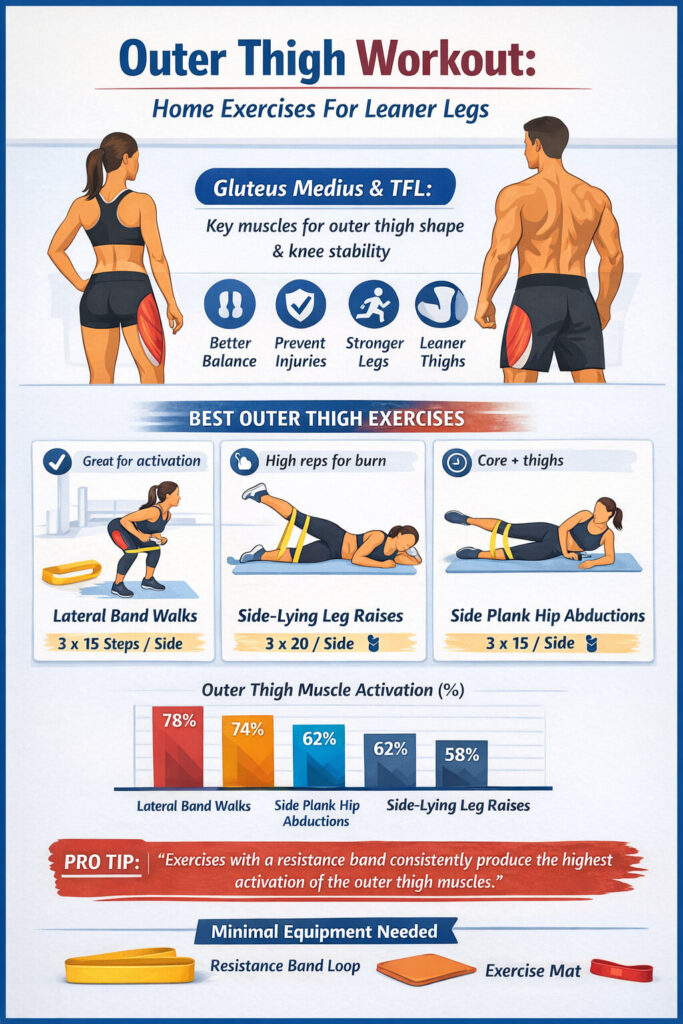
| Lateral Band Walks | 3 | 15 steps each side |
| Sumo Squats | 4 | 12 |
| Cable Hip Abduction | 3 | 15 each leg |
| Side-Lying Leg Raises | 3 | 20 each side |
| Skater Lunges | 3 | 12 each side |
Rest 45–60 seconds between sets. Perform this routine 2–3 times per week for best results.
Expert Opinions
“Weak hip abductors are one of the most common contributors to knee and hip injuries. Training the outer thighs isn’t optional—it’s essential.”
— Dr. Brad Schoenfeld, PhD, Exercise Science Researcher
“If you want stronger legs and better balance, lateral movements must be part of your program.”
— Kelly Starrett, Physical Therapist & Mobility Expert
Common Mistakes to Avoid
| Mistake | Why It’s a Problem |
|---|---|
| Using momentum | Reduces muscle activation |
| Ignoring mind–muscle connection | Limits hypertrophy |
| Training only machines | Neglects stabilizers |
| Skipping warm-ups | Increases injury risk |
Final Takeaway
Outer thigh workouts are not about spot fat reduction—they’re about building strong, functional muscles that improve movement quality and aesthetics together. By prioritizing lateral movements, progressive resistance, and proper technique, you’ll develop thighs that are not only leaner but also more resilient and powerful.
